New to crypto? No stress. If bitcoin has ever sounded like something you need a computer science degree to understand, this beginner’s guide is for you. It’s for people who have never bought crypto, never opened a cryptocurrency wallet, and want to understand what they’re looking at first.
Here’s what you’ll walk away with:
- What bitcoin is, in plain words, and why only 21 million will ever exist
- How the bitcoin network and blockchain technology actually work
- How bitcoin compares to other crypto assets, fiat currencies and traditional money
- How buying bitcoin works on a crypto exchange, step by step
- The difference between hot wallets and cold wallets, and how to protect your private key
- The risks, the tax question, and a checklist to work through before you start investing
This is an explainer, not a nudge to buy anything. Also, take a look at Pigto’s tips for getting started in the crypto world.
What Is Bitcoin (BTC)?
Bitcoin is a decentralized digital currency. Its ticker, the short code you’ll see on any exchange or price app, is BTC. The idea was published in a paper in 2008 under the pseudonym Satoshi Nakamoto, whose real identity is still unknown, and the network went live on 3 January 2009 when its first block was mined.
The word “decentralized” is doing a lot of work there. No central authority sits behind bitcoin: no company issues it, no central bank sets its supply, and no financial institution approves your payment. A worldwide network of computers keeps the same shared record and agrees on what’s true.
Supply is the part most people remember. Only 21 million bitcoins will ever be created, and that limit is written into the software itself. Roughly 20.09 million were in circulation as of September 2026, according to Bybit’s market data. Unlike traditional money, no one can decide to print more.
You don’t need a whole one. Bitcoin can be divided into 100 million smaller units called satoshis, so buying 0.002 BTC is completely normal. That matters, because bitcoin prices are high: BTC traded around $76,600 on 18 September 2026 (Bybit), giving it a market value of about $1.54 trillion, the largest cryptocurrency by some distance.
People use bitcoin two ways: as money, to transfer crypto to someone else or pay merchants who accept bitcoin, and as a store of value, the “digital gold” argument, where the appeal is fixed supply rather than day-to-day spending.
How Bitcoin Works: Blockchain Technology
Every payment you’ve ever made ran through someone’s books. Your bank keeps a ledger and you trust it to be honest. Bitcoin replaces that single bookkeeper with a public record that thousands of computers hold copies of. That record is the blockchain.
When you send bitcoin, your transaction is broadcast to the whole network. It waits in a queue with other cryptocurrency transactions until a miner picks it up and packs it into a block, which is simply a batch of transactions with a timestamp. Blocks are added roughly every ten minutes.
Consensus is how strangers agree on one version of that record without a referee. Miners compete to solve a hard mathematical puzzle, a process called proof of work, and the winner adds the next block. Everyone else checks the result. Cheating would mean out-computing the entire honest network.
Once a transaction is confirmed, it can’t be reversed. There’s no chargeback and no undo. Send bitcoin to the wrong address and it’s gone. That’s the biggest mental adjustment coming from a bank account.
Blockchain Technology Basics
Three words cover most of it.
A ledger is a list of who paid whom. A block is a page of that list. Hashing is one of the cryptographic techniques behind it, squeezing any amount of data into a short fingerprint. Change one character and the fingerprint changes completely.
Here’s the trick that holds it together. Each block contains the hash of the block before it:
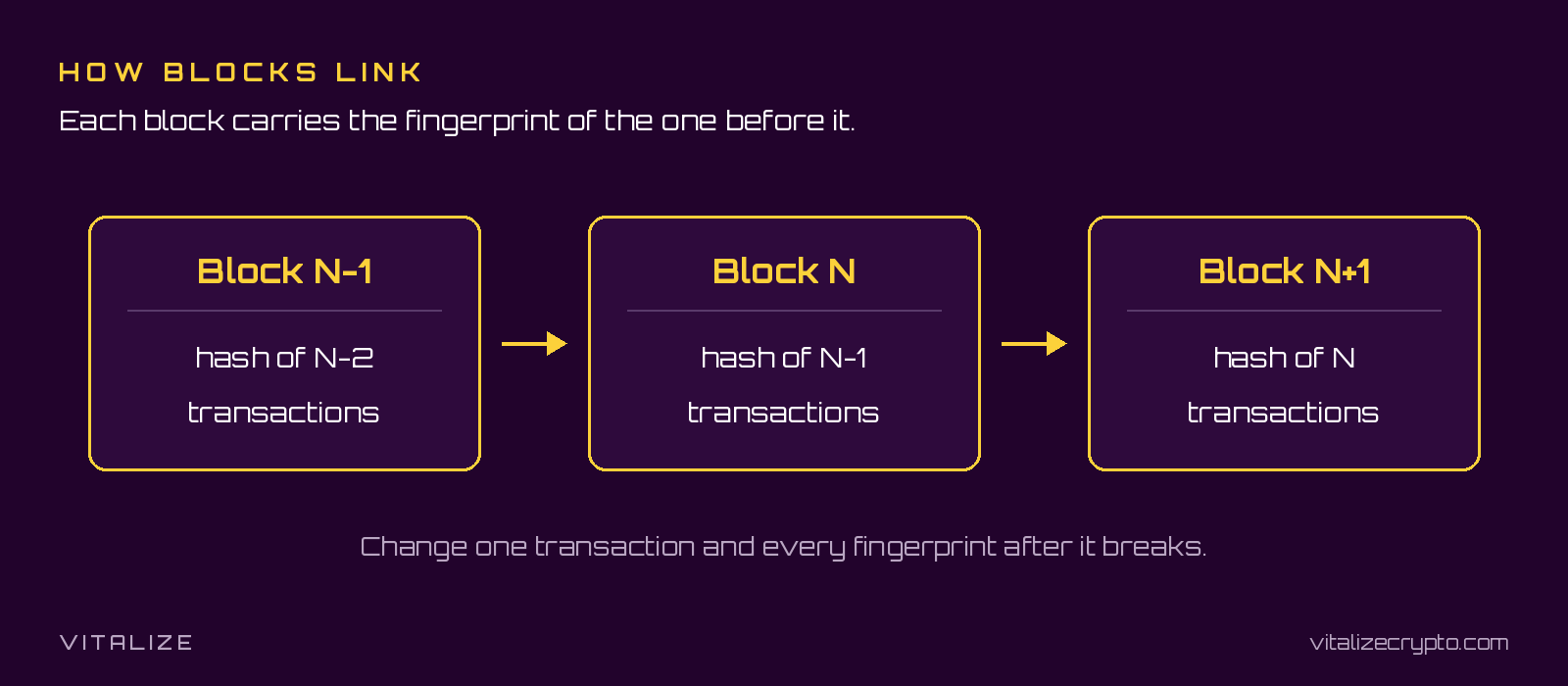
Edit an old transaction and that block’s fingerprint changes, which breaks the next block, and the next, all the way down the chain. Everyone notices instantly.
Mining adds new blocks, and it’s an industrial job now: it takes specialized hardware and software, not a laptop. Miners earn new coins plus transaction fees. That reward halves every 210,000 blocks: it dropped to 3.125 BTC per block on 20 April 2024, and the next halving is expected around April 2028 (Source: CoinGecko). This is how peer-to-peer transactions happen without intermediaries. Cryptography does the job that a financial institution used to do.
Bitcoin Among Digital Assets and Digital Currencies
Bitcoin was the first cryptocurrency, but it’s now one of thousands of digital assets. A quick map of the neighbourhood.
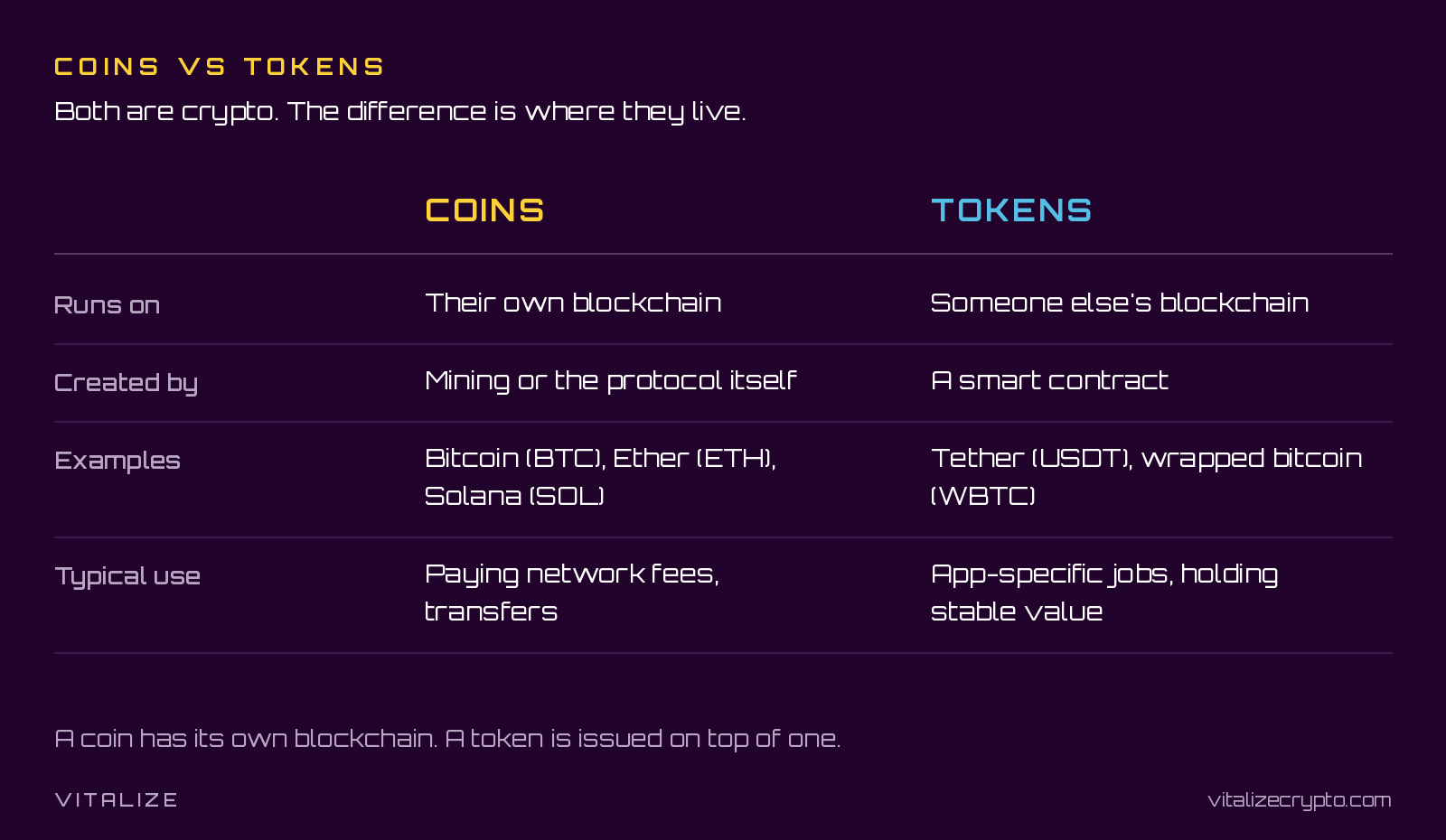
Ether (ETH) powers Ethereum, the second most valuable cryptocurrency, which is built for decentralized applications, programs that run on a blockchain instead of a company’s servers. Stablecoins like Tether are tied to fiat currencies such as the US dollar, so one token is meant to stay worth about one dollar. Altcoins is the catch-all for everything else, including Cardano and Solana.
Crypto exists as coins or tokens, and the difference is simpler than it sounds:
Bitcoin as a Digital Currency
Compare bitcoin to the digital money in your banking app. That balance is digital too, but it’s a claim on a financial institution, backed by a central bank and reversible by both. Bitcoin you hold directly, and it settles without permission. The tradeoff: no bank means no one to call, and fiat currencies stay roughly stable day to day while bitcoin doesn’t.
Using a Crypto Exchange To Buy Bitcoin
A crypto exchange is a marketplace that matches buyers and sellers, and it’s where most people start.
Centralized exchanges hold your money and your crypto for you, the way a broker does. You can buy bitcoin on exchanges like Coinbase and Binance with a bank transfer or card, and they handle the technical side. Availability depends on where you live. Decentralized exchanges let you trade directly from your own wallet, with no company in the middle. They never take custody of your funds, but they’re unforgiving of mistakes and a hard place to start.
What To Check Before Buying Bitcoin
Compare fees and services rather than picking the first app you see. Look at trading fees, deposit and withdrawal costs, the spread between buy and sell prices, which payment methods work in your country, and whether the platform meets local regulatory requirements. Regulatory compliance is a feature, not paperwork: a licensed exchange has rules it must follow about your funds.
Expect identity checks. Many exchanges and services require KYC (Know Your Customer) verification, which means uploading an ID document and sometimes a selfie. It usually takes a few minutes to a day.
How To Buy Bitcoin: Step-by-Step
1. Choose a crypto exchange that serves your country, supports your currency, and publishes its fees clearly.
2. Create and verify your account. Register, complete the KYC steps, and turn on multi-factor authentication straight away.
3. Fund the account. Bank transfer is usually cheapest. Cards are faster and cost more.
4. Place your order. A market order buys immediately at the current price. A limit order buys only at a price you set, and waits. Enter the amount in euros or dollars if that’s easier, since you’re buying a fraction of a coin either way.
After the purchase, your bitcoin sits in the exchange’s wallet, which brings us to the next question.
Wallets And Storing Digital Assets
A cryptocurrency wallet doesn’t hold coins. It holds keys. A public key works like an email address: share it and people can send you bitcoin. A private key is what authorises spending. Whoever holds the private key controls the coins, which is why it must never be shared, screenshotted, or typed into a website.
A simple wallet setup can be nothing more than a reputable exchange or a well-reviewed app on your mobile device. That’s fine for small amounts and beats doing nothing.
Hot wallets are connected to the internet: exchange accounts, phone apps, browser extensions. Convenient, quick, and more exposed to hacks and phishing. Cold wallets keep your keys offline, usually on a small hardware device that signs transactions without ever revealing the key. Slower to use, much harder to attack, and the standard approach for larger holdings.
Setting up a hardware wallet looks like this:
- Buy the device from the manufacturer directly, never second-hand, then install the official app and confirm the device is genuine.
- Let the device generate your seed phrase, the list of 12 or 24 words that can restore your wallet.
- Write the words on paper in order. Never photograph them, never store them in a cloud note, never type them anywhere except into the device itself.
- Store the paper somewhere safe and dry, and consider a second copy in a different location.
- Send a small test amount first, then the rest.
PSA: never share your seed phrase. Anyone who asks for it, including “support”, is stealing from you. And if you lose it, no one can recover your coins. Lose access to your keys and the bitcoin stays visible on the blockchain forever, unspendable.
Define Your Investment Goals Before Buying
Vitalize doesn’t tell anyone what to buy, how much, or when. What we can do is lay out the questions people work through before they start investing, so you can answer them yourself or with a professional.
What are you here for? Curiosity, long-term exposure and the ability to send money across borders are different investment goals, and they lead to different decisions.
What’s your time horizon? The years before you’d need this money back change how much short-term movement you can live with.
What’s your risk tolerance? A standard way to frame allocation is how much you could lose without it changing your life. Bitcoin is a highly volatile asset, so the question isn’t theoretical.
What is dollar-cost averaging? Buying a fixed amount at regular intervals instead of all at once, which spreads your entry price across time. Many investors use it, it guarantees nothing, and whether it suits you is your call.
Key Considerations Before Investing
These are the key considerations most investor alerts keep repeating, and they’re worth your attention.
Volatility. Bitcoin has swung dramatically throughout its history. It reached an all-time high near $126,000 in early October 2025 and traded around $76,600 on 18 September 2026 (Sources: CoinDesk and Bybit), roughly 40 percent below that peak. Price swings of thousands of dollars in a day are normal, in both directions.
Scams. Phishing sites that mimic your exchange, fake support accounts, “giveaways” that ask you to send bitcoin first. The common thread is urgency. Real platforms never ask for your private key or seed phrase.
Security risk beyond scams. Exchanges have been hacked and have gone bankrupt. Holding crypto assets on a platform means trusting that platform.
Concentration. Diversification across asset classes is a standard idea in traditional investments, and crypto doesn’t suspend it. How you apply it is a question for you and, ideally, a licensed advisor.
Decentralized Finance (DeFi) And Bitcoin
Decentralized finance, usually shortened to DeFi, is a set of financial products built as decentralized applications: lending, trading and interest-bearing services that run on code instead of inside a bank.
Most DeFi runs on Ethereum and similar networks rather than on bitcoin, so bitcoin usually joins through wrapped bitcoin, a token on another blockchain that is backed one-to-one by real BTC held in custody. That lets bitcoin exposure move inside DeFi apps.
Bitcoin lending and yield options exist too, on DeFi protocols and through centralized companies. They stack risks on top of bitcoin’s own: smart contract bugs, custody failures, liquidation if you borrowed against your coins. Advertised yields are not bank interest, and several large lenders have collapsed. Understand the mechanism fully before going near it.
Taxes, Regulation, And Safety
Tax rules depend entirely on the country you live in. Buying, selling, swapping or spending bitcoin can produce taxable events, and treatment varies widely by jurisdiction. In the United States, for example, the IRS treats bitcoin as property. Elsewhere the logic is different. Keep meticulous records of every transaction with dates, amounts and prices, and ask a local tax professional. We can’t advise on this, and neither can anyone who doesn’t know your country.
Regulation differs by jurisdiction too. New York has some of the strictest crypto rules in the United States and requires a specialized license called a BitLicense, so the list of platforms authorised to serve New Yorkers is shorter than elsewhere. Check what’s legal and licensed where you are before signing up.
On safety, the basics do most of the work: multi-factor authentication on every account, a unique password per platform, bookmarks instead of search results when you visit an exchange, and a healthy suspicion of anyone who contacts you first.
Beginner’s Guide Checklist
Work through this before you spend anything:
- Read enough that you could explain bitcoin to a friend
- Decide what this money is for, and that you could lose it
- Check which exchanges are licensed in your country, and compare their fees
- Open an account and complete KYC verification
- Turn on multi-factor authentication
- Decide where the coins will live: exchange, app wallet, or hardware wallet
- If hardware: set it up, back up the seed phrase on paper, test with a small amount
- Start a simple record of every purchase for tax season
Five safety practices to keep forever: never share your seed phrase, never click crypto links in emails or DMs, always send a test transaction first, keep multi-factor authentication on everything, and assume anyone promising guaranteed returns is lying.
Further Learning And Resources
Start with the bitcoin whitepaper at bitcoin.org, nine pages and more readable than you’d expect. Bitcoin Optech and the Bitcoin Core documentation are the deep end, where developer resources live.
For prices and market data, CoinGecko and CoinMarketCap are the standard free trackers, and most exchanges include a portfolio view. The Vitalize community is on Telegram at t.me/vitalizecryptoblog, and the Learn section of this site covers wallets, fees and security in more depth.
Conclusion: Next Steps For New Bitcoin Investors
You’ve got the shape of it now. Bitcoin is a fixed-supply digital currency recorded on a public blockchain, you buy it in fractions through an exchange after verifying your identity, and you store it in a hot or cold wallet whose private key only you control.
The next steps are the boring ones: work out why you’re here, write down what you’d be comfortable losing, compare a few licensed exchanges, and run the checklist before you purchase anything. Set goals you can measure, even if that’s understanding one new concept a week. Doing nothing yet is a legitimate choice.
Take it slowly. The market will still be there next week and it is still worth getting into Bitcoin!
Vitalize does not provide financial advice. None of the information provided constitutes investment advice or a recommendation to buy or sell any asset.